After three straight 100-loss seasons, the Chicago White Sox have qualified for the postseason. Just two years ago, the low point came as the franchise endured a Major League record 121-loss campaign.
The turnaround comes just over two decades following one of the most memorable seasons in franchise history. For Chisox fans, the 2005 season was exactly that kind of season.
For 88 years, the franchise had waited for another World Series championship. Generations of fans had grown up without seeing their team win baseball’s ultimate prize. The 1959 AL pennant had become part of franchise history, but the championship that followed it never arrived.
Then came 2005. A team built around pitching, defense, speed, timely hitting, and a remarkable sense of togetherness marched through the American League and eventually swept the Houston Astros in the World Series.
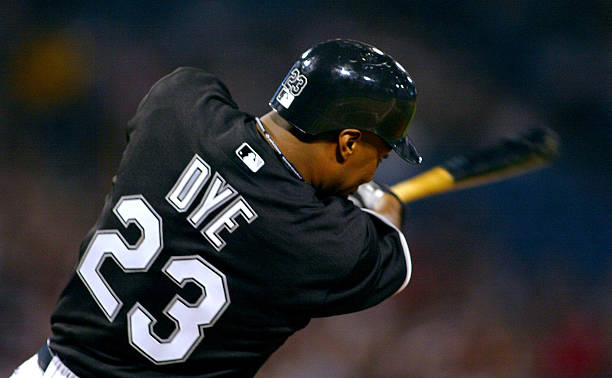
At the center of that unforgettable October stood a veteran outfielder named Jermaine Dye. He didn’t just help the White Sox win the championship. He became the player who delivered the final offensive blow that put Chicago on the doorstep of history.
Dye was rewarded with the World Series MVP Award. Years later, the story of the 2005 White Sox remains one of the most remarkable championship stories in modern baseball. Dye’s story is inseparable from it.
When Dye signed with Chicago in December of 2004, he was hardly an unknown commodity. He had been an AL All-Star with the Royals in 2000 and had established himself as a dangerous middle-of-the-order hitter.
That 2000 season was particularly impressive: he hit .321 with 33 home runs and 118 RBIs.
There had also been adversity. Dye had dealt with injuries and inconsistent seasons, including his time with Oakland, and by the time he joined Chicago, he was entering another important stage of his career.
However, the White Sox saw three things they needed: power, experience, and defense. And a professional approach that could complement the rest of their roster. Dye responded with a strong first season in Chicago.
He played 145 games and hit .274 with 31 home runs, 86 RBIs, 29 doubles, and 11 stolen bases. His 31 home runs led all major-league right fielders, while his nine outfield assists led the White Sox.
He was part of an offense that did not depend on one player. With veterans like Paul Konerko, Scott Podsednik, and A.J. Pierzynski, the team’s identity was becoming clear. They wanted to defend, run, and take advantage of opportunities.
The foundation was also their starting rotation. With a staff that included Jon Garland (18-10), Mark Buehrle (16-8), José Contreras (15-7), and Freddy García (14-8), they helped lead Chicago to an AL-best 99 victories and the Central Division crown.
The first test came against the defending World Series champion Boston Red Sox. Boston had won the 2004 World Series after overcoming an historic deficit against the New York Yankees in the ALCS.
The White Sox didn’t blink. They swept Boston three games to none. Chicago wasn’t simply happy to be in the postseason. This team believed it belonged. The ALCS brought another challenge.
The Los Angeles Angels stood between Chicago and the World Series. Again, the White Sox delivered. They defeated Los Angeles four games to one. After beating Boston and Los Angeles, Chicago was going to the World Series for the first time since 1959.
But there was still one enormous obstacle: the Houston Astros. The Fall Classic was a matchup between two franchises still searching for their first championship. Houston had never won a World Series. Chicago had not won one in 88 years.
The series opened at U.S. Cellular Field on the South Side. The Chisox held serve by winning both games in Chi-Town. Following the 5-3 Game 1 win, Game 2 was an offensive thriller.
Konerko delivered a go-ahead grand slam, and Podsednik later hit a walk-off home run, sending the Chicago crowd into a frenzy. The White Sox won 7-6 to take a two-game lead moving to Houston.
Game 3 became one of the most memorable contests in World Series history. It lasted 14 innings. With the score tied, Geoff Blum—a midseason acquisition who had been playing against his former team—hit a home run in the top of the 14th inning.
Chicago eventually won 7-5 to take a commanding 3-0 lead. But Game 4 would be completely different. There would be no offensive explosion. There would be no dramatic slugfest. Instead, the game became a classic pitcher’s duel.
For seven innings, neither team could score. In the eighth inning, Chicago manager Ozzie Guillén began making moves. Willie Harris came off the bench and singled. Podsednik laid down a sacrifice bunt.
Following a Carl Everett groundout, Harris was standing 90 feet from home plate. The Astros brought in closer Brad Lidge. Then Dye walked to the plate. There was no need for a home run. No need for a spectacular swing.
Dye delivered a single up the middle, his third hit of the game. Harris scored, and Chicago had a 1-0 lead. The bottom of the eighth and ninth innings became a celebration waiting to happen.
Bobby Jenks entered and recorded the final outs. Juan Uribe made a crucial defensive play in the ninth inning, reaching into the stands to catch a foul ball and help preserve the lead.
Then came the final out. The Chicago White Sox were World Series champions. For the first time since 1917, they had won baseball’s championship. The drought was over.
Dye hit .438, going 7-for-16 with one home run and three RBIs. His performance included the championship-clinching hit in Game 4. He was tabbed as the World Series MVP and recipient of the Babe Ruth Award for the postseason.
But perhaps the most important statistic was not the batting average. It was the timing. Dye produced when Chicago needed him. His single in Game 4 didn’t merely add another hit to his postseason statistics.
It scored the run that ended an 88-year wait. That is the kind of moment that changes how a player is remembered. That season, every player seemed to have a moment, which was the personality of the 2005 White Sox.
Chicago finished the postseason 11-1, including sweeps of Boston and Houston and a 4-1 victory over the Angels in the ALCS. It tied the 1999 Yankees for the second-best postseason winning percentage at the time, behind the 1976 Reds’ 7-0 postseason.
Dye’s career did not end with the 2005 championship. In fact, the following season was arguably his best individual season. In 2006, Dye hit .315 with 44 home runs and 120 RBIs. He made his second All-Star team and won the Silver Slugger Award.
And he finished fifth in AL MVP voting. His 44 home runs were a career high, and he became one of four White Sox players to hit at least 30 home runs that season. But statistics tell only part of Dye’s story.
His name had become connected permanently with the most important championship in White Sox history. From 2005 through 2009, Dye played five seasons with Chicago and became one of the recognizable figures of that era.
He hit .278 with 164 home runs and 461 RBIs over 724 games during his White Sox tenure.
The championship had transformed his relationship with the city. He represented the veteran presence the White Sox needed and provided power during the regular season. On March 31, 2011, Dye announced his retirement.