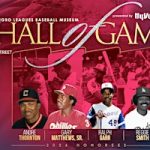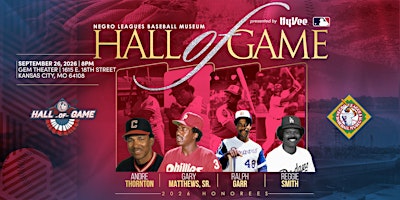
On September 26, at the Gem Theater in Kansas City, the Negro Leagues Baseball Museum will induct its Hall of Game Class of 2026. This year’s honorees include these former MLB bros: Andre Thornton, Gary Matthews Sr., Ralph Garr, and Reggie Smith.
Four careers that carried the spirit of Negro League baseball into the modern game without ever wearing a Negro League uniform. However, the Hall of Game doesn’t honor stats alone.
Since 2014, the museum has recognized major leaguers who played with the passion, skill, and — as museum president Bob Kendrick likes to say — “a little swag” that defined the Negro Leagues.
This year’s class echoes the unique tradition that epitomises that same spirit. Also, MLBbro.com founder Rob Parker will receive the second annual JL Wilkinson “Innovator” Award, named for the Kansas City Monarchs owner who pioneered night baseball.
Let’s look at the legacy of these MLB bros.
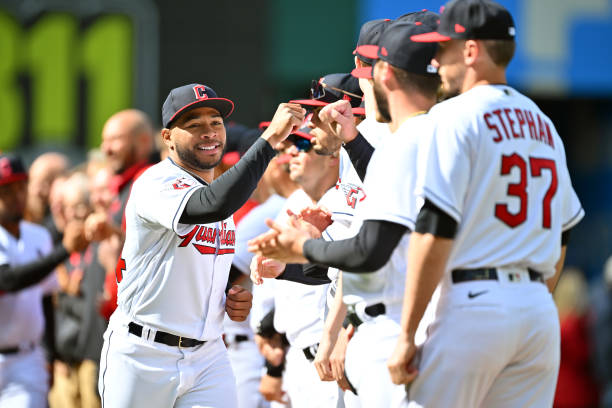
ANDRE THORNTON
Thornton didn’t get his “Thunder” nickname by accident. The man hit baseballs like he had a personal grievance with them. Over 15 seasons — the majority with Cleveland — Thornton slugged 253 home runs, added 895 RBI and a .360 on-base percentage.
He made the All-Star team twice (1982, 1984), won the Silver Slugger as the AL’s best-hitting designated hitter in ’84, and amassed three seasons of 32-plus home runs in an era when Cleveland didn’t provide him much lineup protection.
But the numbers don’t tell the whole story. In 1977, Thornton lost his wife Gertrude and young daughter Theresa in a car accident on a Pennsylvania highway. He was in the car. His son survived.
Thornton came back to baseball carrying a weight that had nothing to do with the lumber in his hands, and he played another decade — channeling his grief into his faith, his community, and eventually his 1983 book, “Triumph Born of Tragedy.”
Cleveland inducted him into their franchise Hall of Fame in 2007.
GARY MATTHEWS SR.
The classic nickname says it all – “The Sarge”. He walked onto a baseball field the way a drill sergeant walks into a barracks — commanding, intense, and completely in charge.
Sixteen seasons. Five teams. The numbers speak for themselves: 2,011 hits, 234 home runs, 978 RBI, 183 stolen bases, 940 walks, and a .281 career average. Sarge didn’t give at-bats away.
He announced himself in 1973, winning NL Rookie of the Year with the Giants — .300, 162 hits, 12 home runs right out of the gate. He peaked with the Braves in 1979, hitting .304 with 27 homers and 90 RBI.
But the signature moment — the one that made Sarge immortal in Philly — was the 1983 NLCS. Against the Dodgers, Matthews went 6-for-14 with three home runs, eight RBI, and a 1.571 OPS across four games. He was named the NLCS MVP.
He carried the Phillies to the World Series on his back, and the city never forgot it. Later, as a beloved Phillies broadcaster, he kept his voice in the game long after the cleats came off.
RALPH GARR
Garr didn’t hit home runs. He didn’t need to. He hit everything else. A .306 career batting average over 13 seasons tells you what kind of hitter Garr was — pure contact, line drives to all fields, and the speed to turn singles into doubles and doubles into triples.
He stole 172 bases, won a Gold Glove in 1971 with the Braves, and legged out everything he could reach. The peak was 1974, and it was spectacular. Garr won the NL batting title by hitting .353, led the league with 214 hits and 17 triples, and made the All-Star team.
That .353 mark was one of the best batting averages of the entire decade. Two years earlier, he’d collected 219 hits — numbers that put him in conversation with the great contact hitters of any generation.
The “Roadrunner” nickname captured his whole game: speed, daring, relentless pressure on the defense. Garr played the way the old Negro Leaguers played — slapping balls through holes, creating chaos on the basepaths, forcing the other team to react to him.
Back in his college days at Grambling State University, Garr led the NAIA in batting with a .585 mark in 1967. If the Hall of Game is about style, the Roadrunner might be the most stylish player in this class.
REGGIE SMITH
Smith might be one of the most underrated switch-hitters in baseball history. Read the numbers and try to argue otherwise. Over 17 seasons with the Red Sox, Cardinals, Dodgers, and Giants, Smith hit .287 with 314 home runs, 1,092 RBI, and an .855 OPS.
He was a seven-time All-Star and a Gold Glove winner in 1968. He played on four World Series teams — Boston in ’67, Los Angeles in ’77, ’78, and ’81 — and won it all with the Dodgers in 1981.
In 21 World Series games, he slugged .521 with six home runs. His 314 home runs rank fourth all-time among switch-hitters — behind only Mickey Mantle, Eddie Murray, and Chipper Jones. When Smith retired, only Mantle was ahead of him.
Smith grew up in Compton idolizing Jackie Robinson, then became a Dodger himself and hit .297/.387/.528 in 542 games wearing blue. The most complete player in this class — power, average, defense, baserunning — and somehow still not in Cooperstown.
Earlier this month, on August 15th, Smith was inducted into the Dodgers’ Hall of Fame.
A COMMON THREAD
None of these four played in the Negro Leagues. Their careers spanned the post-integration era, from the late ’60s through the late ’80s. But the Hall of Game was never about who wore a Kansas City Monarchs or Pittsburgh Crawfords jersey.
It’s about who played the game the way the Negro Leaguers played it — with personality, with fire, with visible joy. They played in an era when Black players were no longer fighting for access but were still fighting for recognition — for equal endorsement dollars, for front-office opportunities after retirement, for the right to be remembered as more than supporting cast.