When reflecting on the 17-year career of Garret Anderson, the one word that comes to mind is consistency. To put it into perspective, during the period between 1997 and 2003, only Hall of Famers Derek Jeter and Todd Helton had more hits than the native of Los Angeles.
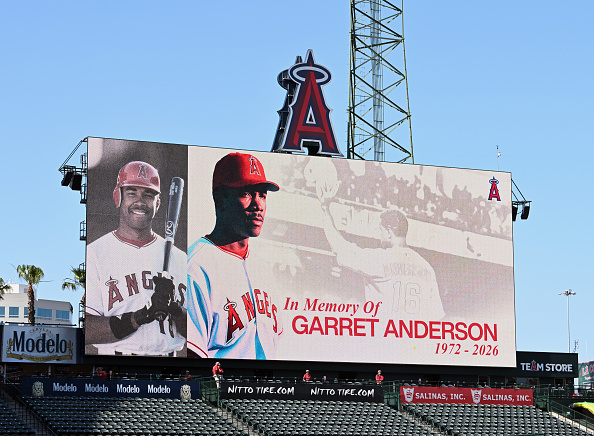
Anderson, who played the majority of his career (15 seasons) with the Los Angeles Angels franchise, passed away on Friday at the age of 53. Anderson’s cause of death has yet to be reported.
A key member of the Angels’ 2002 World Series title team, Anderson remains atop the franchise all-time list in several offensive categories including games (2013), at-bats (7989), runs (1024), hits (2368), total bases (3743), extra-base hits (796), doubles (489) and RBI (1292).
A three-sport athlete (baseball, football, and basketball) at Kennedy High School in Granada Hills. In baseball, he won two All-Los Angeles City honors and two All-League Honors, and as a junior, helped his team win the Los Angeles City Championship.
In basketball, as a senior he won All-Los Angeles City honors and All-League honors. Anderson would accept a baseball scholarship to Fresno State, but would never play for the Bulldogs. The then California Angels drafted him in the fourth round (125th overall) in the 1990 Amateur Draft.
Eventually, Anderson would make his major league debut on July 27, 1994. He had two hits in four at-bats in that game, recording his first career hit on a single to right field off Oakland’s Ron Darling in the bottom of the third inning.
In his brief stint, Anderson appeared in five games with the Angels in 1994, getting five hits in 13 at-bats. By the time he played his full season in 1995, Anderson quickly established himself in an Angel outfield that included Jim Edmonds in center and Tim Salmon in right.
After being called up for good on April 26th, Anderson hit his first career home run on June 13 against Minnesota’s Kevin Tapani. He was named the AL’s Player of the Month in July after batting .410 with 22 runs scored and 31 RBIs in 25 games.
However, the Angels would suffer one of the worst late-season collapses in MLB history. On August 16, they held a 10.5-game lead over the Texas Rangers and an 11.5-game lead over the Seattle Mariners.
The team went through a late season slump, including a nine-game losing streak from August 25 to September 3. They rebounded to win their last five regular season games to finish tied with Seattle for the AL West lead.
But the Mariners defeated the Angels 9-1 in the one-game tiebreaker to win the division. On the year, Anderson batted .321 in 106 games with 16 home runs and 69 RBIs, and finished second in the AL Rookie of the Year voting to Minnesota’s Marty Cordova.
From that point forward, Anderson would become a mainstay in the Angels lineup. Over the next eight seasons, he accumulated at least 600 at bats every year, breaking 90 RBI and 20 home runs five times while compiling a batting average near .300.
Anderson hit a career-high 35 home runs in 2000. By 2002, the Angels were still longing for a championship. Eventually, it would come to fruition and it was Anderson who was one of the major catalysts.
During the year, he compiled a .306 average with 29 home runs and 123 RBIs. He maintained that similar consistency during the postseason. Anderson’s imprint was all over the Fall Classic against the San Francisco Giants.
In the first World Series that featured a pair of Wildcard squads, Anderson went 9-for-32 in the seven-game series, driving in six runs, including the third-inning, three-run double off Livan Hernandez that broke a 1-1 tie.
The hit was the difference-maker in the Halos’ 4-1 win in Game 7 over the Giants. Anderson also had a game-tying RBI single that was pivotal in the Angels’ 11-10 win in Game 2, and he scored the go-ahead run in the Game 6 victory that forced the decisive Game 7.
The Halos overcame a 3-2 series deficit to outlast Barry Bonds and the Giants.
Anderson had another strong season in 2003, and was named an AL All-Star. That All-Star weekend, he became the Home Run Derby Champ and voted the MVP in the All-Star Game, the first player to win both since Cal Ripken in 1991.
In 2002 and 2003, Anderson tied for the AL lead in doubles with Boston’s Nomar Garciaparra and Toronto’s Vernon Wells, respectively. On April 13, 2004, Anderson agreed to a $48 million, four-year contract extension through 2008.
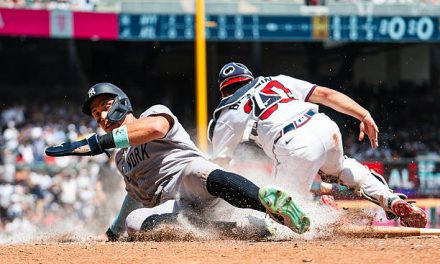
On August 21, 2007, Anderson drove in a team-record 10 runs, including a grand slam and a three-run home run, in the Angels’ 18–9 win over the New York Yankees. Anderson became the 13th player in MLB history to have 10 RBIs in a game.
Later that year on September 7, Anderson drove in a run on an RBI single, to set a franchise record for most consecutive games with an RBI with 11. The streak lasted for 12 games, during which time he drove in 22 runs.
On October 28, 2008, the Angels announced they would decline their $14 million option on Anderson’s contract and exercised a $3 million buyout. After playing for the Braves in 2009 and the Dodgers a year later, Anderson formally announced his retirement in March of 2011.
In 2012, Anderson was an Angels pregame and postgame reporter during home games and some road games on Fox Sports West. His 272 home runs with the franchise are third in Angels’ history, behind Mike Trout and Tim Salmon.
Only Trout has scored more runs in team history than Anderson. In August of 2016, he became the 14th player inducted into the Angels’ Hall of Fame. “The Angels organization is mourning the loss of one of our franchise’s most beloved icons, Garret Anderson,” said Angels owner Arte Moreno in a statement.
“Garret was a cornerstone of our organization throughout his 15 seasons and his stoic presence in the outfield and our clubhouse elevated the Angels into an era of continued success, highlighted by the 2002 World Series championship.”
He’s survived by his wife Teresa, daughters Brianne and Bailey, and son Garret “Trey” Anderson III.